
25 : 9

ANSI, ISO 606 and bicycle chains. Set the chain and teeth, choose the hub and bore, add spokes, and download STL, STEP, DXF or SVG — a single sprocket or a two-sprocket drive with its chain.
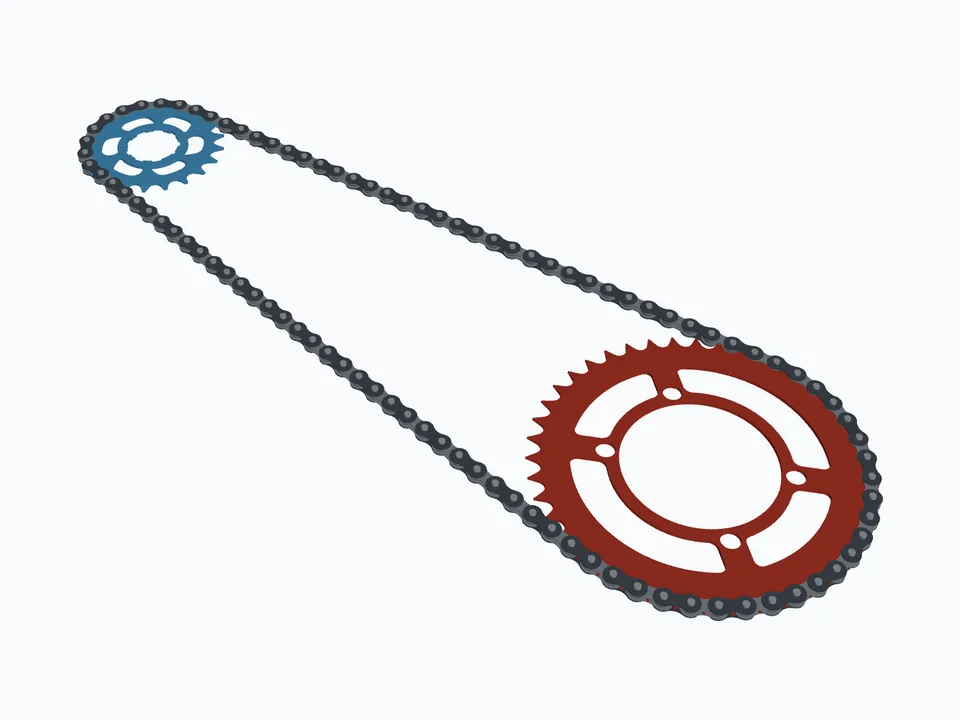
ANSI 25 to 240 and the heavy series, ISO 606 B-series 05B to 72B, and bicycle chains.
The ISO 606 envelope with an adjustable fit, or the ASME B29.1 theoretical form.
One to several strands at the chain's transverse pitch, with the standard tooth width and side chamfer.
ASME hub types A, B and C; round, D-flat, keyway, splined and hex bores; set screws held by the plastic, a captured nut or a heat-set insert.
Straight, tapered, curved and other spoke styles, or round lightening holes.
Chain length in pitches, exact centre distance, and warnings for wrap, ratio and centres.
Cassette cogs and chainrings, with the makers' bolt patterns.
Print compensation for the STL; STEP stays at true size.
STEP, STL, DXF and SVG for each sprocket, the chain and the drive, from the same Download window as the pulley tool.
| Family | Sizes | Source |
|---|---|---|
| ANSI roller chain | 25 – 240, heavy series 60H – 240H | ASME B29.1 |
| ISO 606 B-series | 05B – 72B | ISO 606 |
| Bicycle | 081, 082; 9 – 12 speed | ISO 9633 (and approximations, marked) |
BMX, road, mountain bike, motorcycle and industrial chain drives. Each opens with both sprockets and the chain, ready to change.
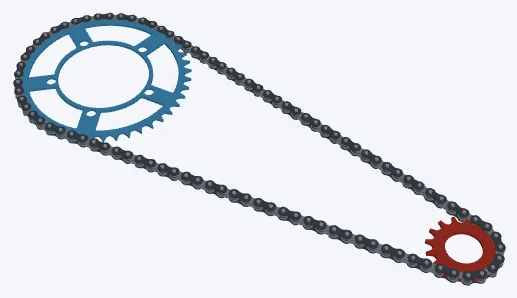

BMX race 44/16
Five-bolt 110 BCD ring with windows between the bolts, on a 16T freewheel cog.
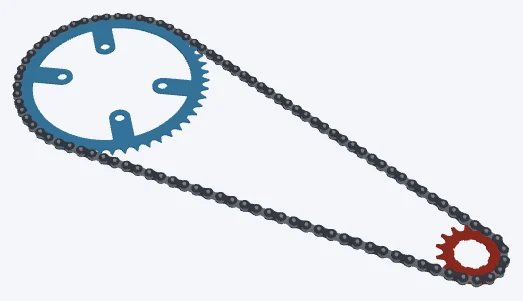

Road 50/34 · 11-28, big ring
Bolt tabs on Shimano's 110 × 4, in a cruising gear.
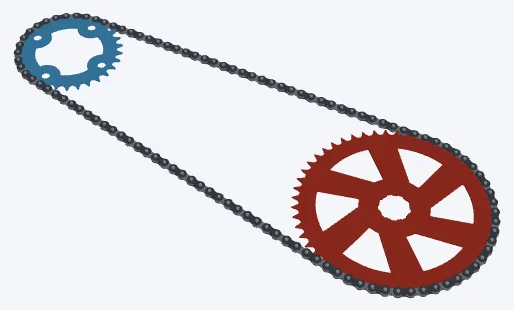

MTB 30T · 10-52, lowest gear
Narrow-wide on SRAM's 94 × 4, in the cassette's lowest gear.
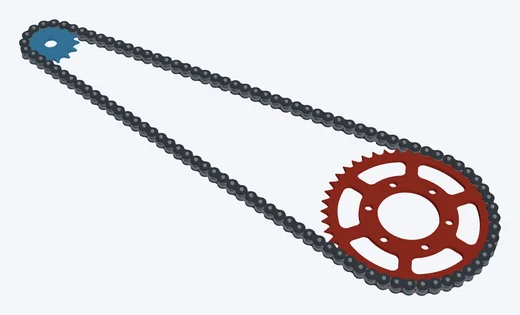

15/43 · 520
The KLR650's stock gearing on 520 chain: a 43T steel rear with six broad spokes and big rounded windows, on Kawasaki's 520 street pattern (6 × 10.5 mm on 104, 80 mm centre).
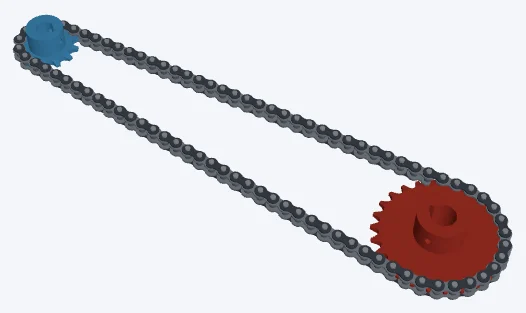

Industrial ANSI 35 · 13/26
Stock-style: Type B hubs, keyed bores, two set screws each.
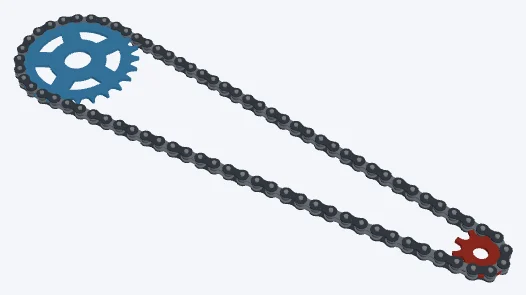

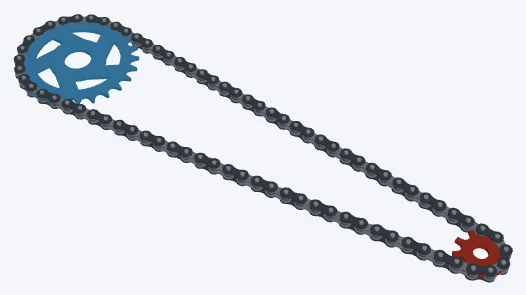
BMX street 25/9
The straight five-spoke street sprocket, after BSD's Guard.
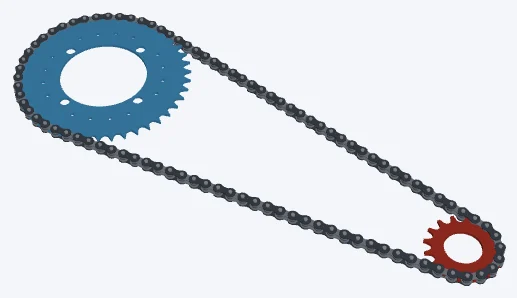

STEP (true nominal size, for CAD), STL (with your print compensation, for 3D printing), and DXF and SVG (true lines and arcs, for laser cutting, waterjet and CAD sketches) — for each sprocket, the chain and the whole drive.
Either. ISO 606 defines an envelope for the tooth space, and the Fit setting chooses where in it your teeth sit; ASME B29.1 gives the American theoretical form. Pick one under Tooth form.
Turn on the two-sprocket drive and set either the chain length in links or the centre distance; the app works out the other and warns when the centres fall outside what ASME B29.1 recommends. Auto-fix sets a chain length that clears the warning.
Yes. Designing and checking are free; downloads cost a few tokens, the same as for pulleys, and one purchase covers every file of that design, and you can download them again at no charge later. See Pricing.