
Which gear do you need?
Start with how your shafts sit. Parallel shafts take spur or helical gears, crossed shafts a worm drive, shafts that meet a bevel pair, and shafts in line a planetary set. Each type has its own tool, built to the standards and checked as you type.
Four layouts, four gear types
| Shafts | Gear type | Ratio in one step | Tool |
|---|---|---|---|
| Parallel | Spur, helical and herringbone gears; internal rings and racks | Up to about 6 : 1 a pair; more with a ring or in stages | Gear Designer Live |
| Crossed at 90°, not meeting | A worm and its worm wheel | About 5 : 1 to 100 : 1 in one step (the app goes to 400 : 1); can self-lock | Worm Gear Designer Live |
| Meeting at an angle | Straight, spiral and hypoid bevel pairs; hypoid shafts are offset | 1 : 1 (miter) to about 6 : 1 | Bevel Gear Designer Coming soon |
| In line (coaxial) | Planetary sets: sun, planets, ring and carrier | About 3 : 1 to 10 : 1 a stage; stages stack | Planetary Gear Designer Coming soon |
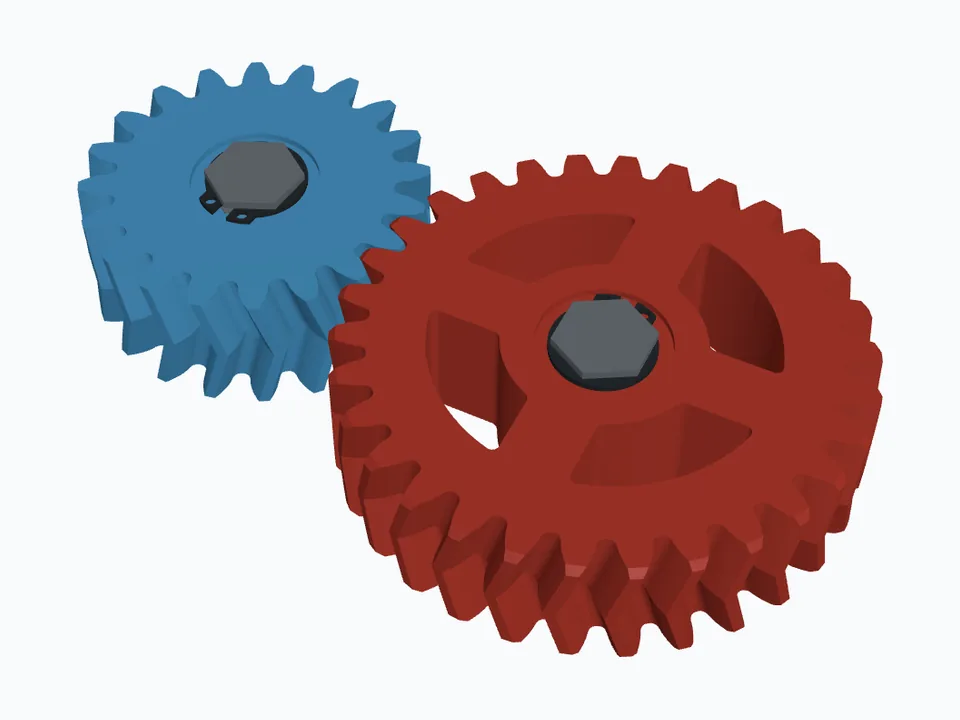
Gear Designer
Involute spur, helical and herringbone gears by module or diametral pitch — single gears, pairs, internal rings and racks, checked against DIN 3960.

Worm Gear Designer
A worm and the wheel it drives, by module or diametral pitch: 1 to 8 starts, ZA, ZN, ZI and ZK threads, the wheel cut by the worm itself.
Bevel Gear Designer
Straight, spiral and hypoid bevel pairs for shafts that meet, or pass close by: miter gears, right-angle drives and any shaft angle from 10° to 170°, with bores and hubs on both parts.
Planetary Gear Designer
A whole planetary gearbox in one design: sun, 1 to 8 planets, ring and carrier, with any member held, up to three stacked stages, and the carrier's pins and bearings.
Choosing between them
Which gear do I need for a 90° turn?
If the shafts meet, a bevel pair: a miter pair for 1 : 1, or a pinion and gear for a reduction. If they cross without meeting and you want a big reduction in one step, a worm and wheel.
Which gears give the biggest reduction?
In one step, a worm drive: 20 : 1 to 60 : 1 is common, and a single-start worm can go much higher. With the shafts in line, planetary stages stack: two 5 : 1 stages give 25 : 1. A spur or helical pair is happiest below about 6 : 1.
Which is the most efficient?
Spur, helical, bevel and planetary meshes each lose only a percent or two. A worm drive loses far more, from about 50 % to 90 % efficient depending on its lead angle, and at low lead angles it self-locks; the Worm Gear Designer's Running check works out both.
Can I 3D-print them?
Yes. Every tool puts your print compensation into the STL only and keeps the STEP at true size. Herringbone teeth keep a printed pair from walking apart along the shafts.
Gearing a bike rather than a machine? The Magic Gear Calculator finds the chainring and cog pairs that fit your frame.
Pick your gear and start typing
No account needed to design. Downloads cost a few tokens.