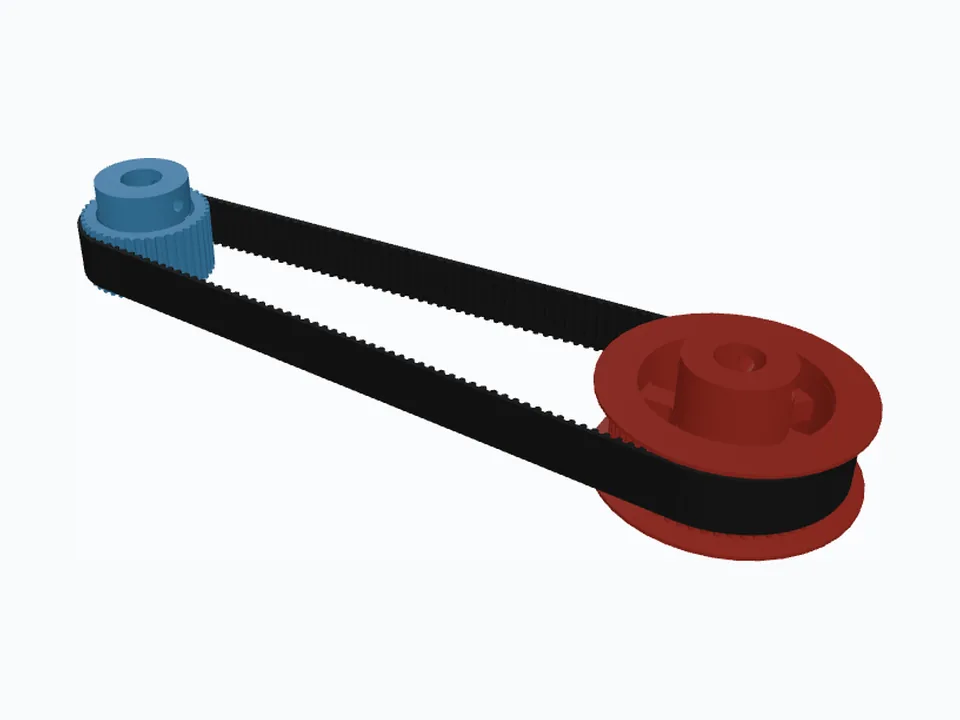
GT2 16 and 24 tooth pulleys tuned for zero backlash
Tuned for positioning rather than power: tight tooth clearance, no backlash allowance and 0.1 mm of print compensation, so the printed teeth hold the belt without slop.
GT2 (2GT)Captured nutFlanges printed in placeZero backlashPrint compensation
Using the CheapCADTools connector, design a two-pulley timing belt drive: GT2 belt (2 mm pitch), 16 and 24 teeth, about 60 mm between centres, tuned for positioning: tight tooth clearance, no backlash allowance and 0.1 mm of print compensation on both. Each has a 5 mm bore and a hub 14 mm across and 7 mm tall with an M3 set screw in a captured nut. Pulley 1 gets printed flanges, with the top flange printed in place. Check the design, apply any Auto-fix it suggests, then export both pulleys as STL and give me the download link.
Paste it into Claude, ChatGPT or any AI app with the CheapCADTools connector, and it designs this drive with you, checks it and hands you the files. How to connect your AI.
What's in this design
The drive
GT2 (2GT) belt, 10 mm wide, 81 teeth (162 mm long)
Centre distance 60.95 mm; ratio 16 : 24 (1 : 1.5)
Pulley 1
16 teeth
5 mm round bore
Hub Ø14 × 7 mm, two M3 set screws in captured nuts
Printed flanges, 1.5 mm thick, reaching 3 mm past the teeth; both print in place
Tight tooth clearance; no backlash allowance
0.1 mm print compensation in the STL
Pulley 2
24 teeth
5 mm round bore
Hub Ø14 × 7 mm, two M3 set screws in captured nuts
Tight tooth clearance; no backlash allowance
0.1 mm print compensation in the STL
In the free STL zip
GT-2M-16T+flange.stl — pulley 1, 16 teeth
GT-2M-24T-P2.stl — pulley 2, 24 teeth
Free STLs are CC BY 4.0, exactly the design as it opens, with its print compensation (pulley 1 0.1 mm, pulley 2 0.1 mm). Open the design to change anything, tune the fit for your printer, or download STEP, DXF, SVG and the belt.
Dimensions — 15 figures from the generator
Pulley 1
Pulley 2
Pitch diameter
10.19 mm
15.28 mm
Outside diameter
9.68 mm
14.77 mm
Outside diameter, as built
9.48 mm
14.57 mm
Root diameter
8.15 mm
13.24 mm
Groove depth
0.76 mm
0.76 mm
Pitch line differential
0.25 mm
0.25 mm
Belt width
10.00 mm
10.00 mm
Face width (belt + clearance)
13.00 mm
13.00 mm
Minimum face width
11.00 mm
13.00 mm
Flange outside diameter
15.48 mm
—
Flange past the OD
3.00 mm
—
Minimum flange height
1.10 mm
—
Belt
81 teeth · 162.00 mm
Centre distance
60.95 mm
Drive ratio
16 : 24 · 1 : 1.5
Read from the generator's Dimensions panel for this design, which opens with no warnings.
Printed and run on a GT2 belt: the 45-tooth pulley is cut down to three spokes on a 1 mm web, both pulleys print their flanges in place on breakaway supports, and two M3 set screws per hub bite into captured nuts.
GT2 (2GT)Captured nutThin-web spokesFlanges printed in placePrint supports
The 3D-printer classic done properly: a D-flat that keys onto the motor shaft, a set screw that bites into a captured nut instead of the plastic, and a 30-tooth partner held by two heat-set inserts.
GT2 (2GT)D-flatCaptured nutHeat-set insertFlanges printed in place
Big printed pulleys don't need to be solid: five and six spokes on a thin centre web cut plastic and print time, while the toothed rim stays full width for the belt.
Printed and run on an S5M 690 belt: a 1 : 5 reduction to a 100-tooth wheel on eight spokes, whose top flange prints as a separate ring and glues on over 40 nubs, while the 20-tooth pulley prints its flanges in place.
STD S5MCaptured nutThin-web spokesFlanges printed in placeAlignment nubs